
Livingston Parish Criminal Court Cases
The Twenty-First Judicial District Court has original criminal jurisdiction in Livingston, St. Helena, and Tangipahoa parishes. The Livingston Parish Clerk Criminal Department handles every parish felony. It also handles misdemeanors and traffic matters that occur outside a municipal court's limits. A docket labeled 21st JDC is not enough by itself. Confirm that the heading names Livingston Parish, then note the division and docket number.
Inside a municipality, city or mayor's court may retain an ordinance, traffic, or qualifying misdemeanor case. The Livingston Parish Clerk explains this split on its Criminal Department page. The clerk receives formal charges from the district attorney and keeps the parish docket, minutes, exhibits, judgments, appeals, and notices. The arrest report remains with the agency that created it.
The official 21st JDC source shows the district court structure.
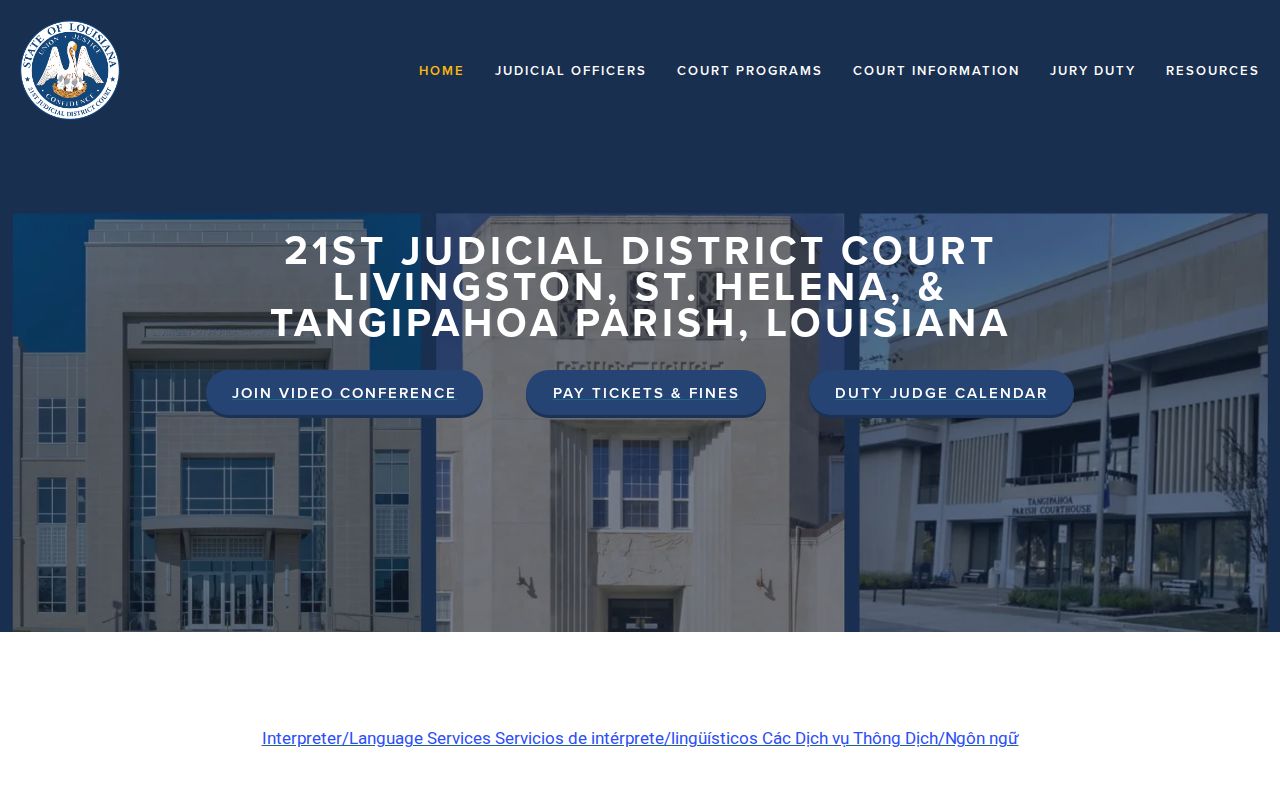
That district scope is why parish, division, and docket identifiers all matter when requesting a Livingston Parish court record.
Livingston Parish Criminal Department
The clerk's criminal desk is the main custodian for a Livingston Parish district court case. Ask for the docket, charging instrument, minutes, disposition, sentence, or copies by defendant name and docket number when known. The courthouse and governmental building is at 20300 Government Boulevard, Livingston, Louisiana 70754. The clerk's main number is 225-686-2216.
Livingston Parish Clerk of Court
Criminal Department
20300 Government Boulevard
Livingston, LA 70754
225-686-2216
The official criminal-services page identifies the department and its duties.
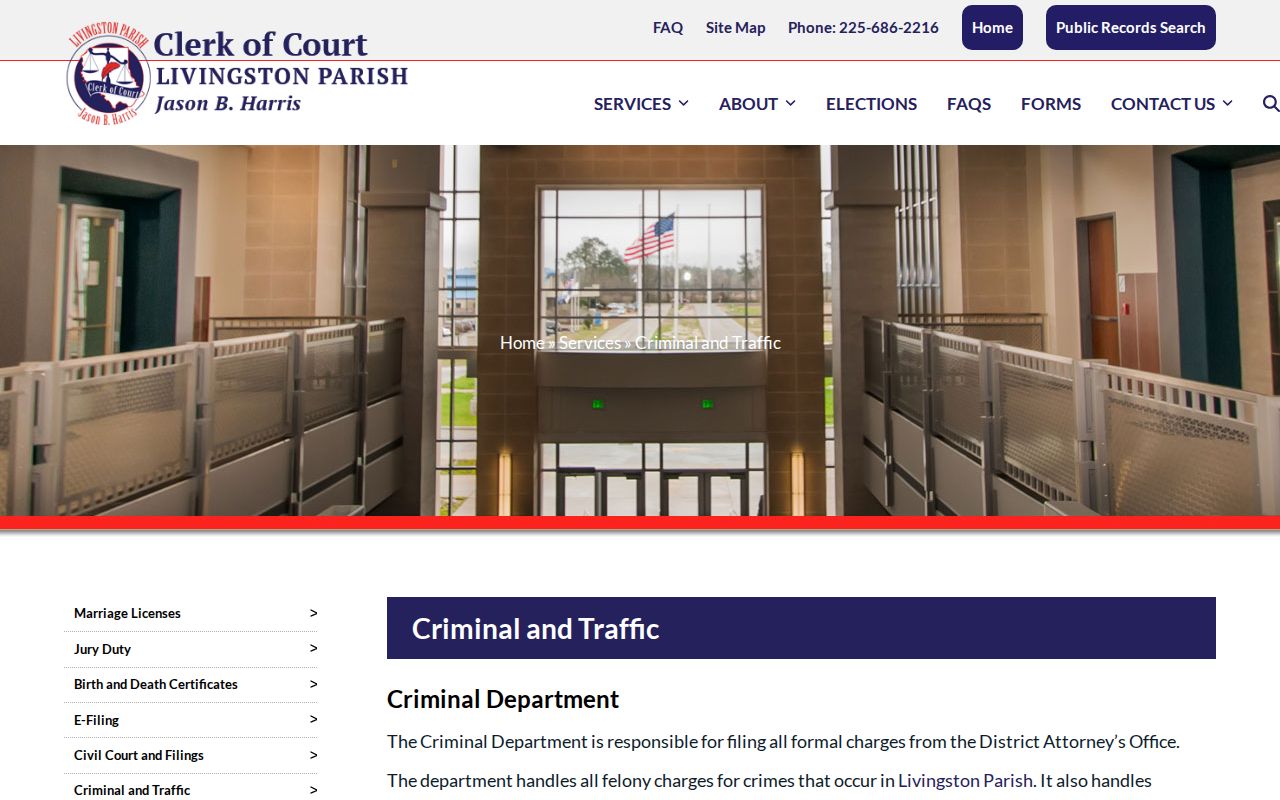
This is the right starting point for filed parish charges, not for the arresting agency's narrative.
Searching Livingston Parish Case Records
No reliable public online criminal search was verified during research. The clerk reported that its internal COTT system had been restored while external viewing was still being restored. Use the counter or a written request when remote viewing is unavailable. A district attorney docket can help identify a setting, but it is a calendar rather than a complete case file.
- Confirm whether the matter belongs to Livingston Parish district court or a city or mayor's court.
- Gather the defendant name, docket number, division, and approximate filing or hearing date.
- Check a published district attorney docket for a possible division, date, and docket number.
- Contact the Livingston Parish Clerk Criminal Department at the counter or in writing for the authoritative file.
- Specify whether you need docket entries, minutes, a disposition, sentence, certified copy, or transcript.
| Field Label | Type | Required | Notes |
|---|---|---|---|
| Defendant name | Text | Yes | Use the legal name and known variants. |
| Docket number | Text | No | Best way to distinguish similar names. |
| Parish | Place | Yes | Specify Livingston within the three-parish district. |
| Division | Text | No | May appear on a docket or prior notice. |
| Hearing date | Date | No | Required with defendant and division for transcript requests. |
Livingston Parish Certified Court Check
The clerk offers a parish-only certified criminal record check for $20. The request form asks for the subject's name, date of birth, Social Security number, race, sex, mailing details, and reason for the request. Payment is by check or money order. The result lists docket numbers, offenses, and brief dispositions found in the Livingston courthouse case-management data. A no-record result is a certified affidavit, not proof that no record exists in another parish, a city court, another state, or the federal system.
The clerk's certified-check instructions state the local scope and payment method.
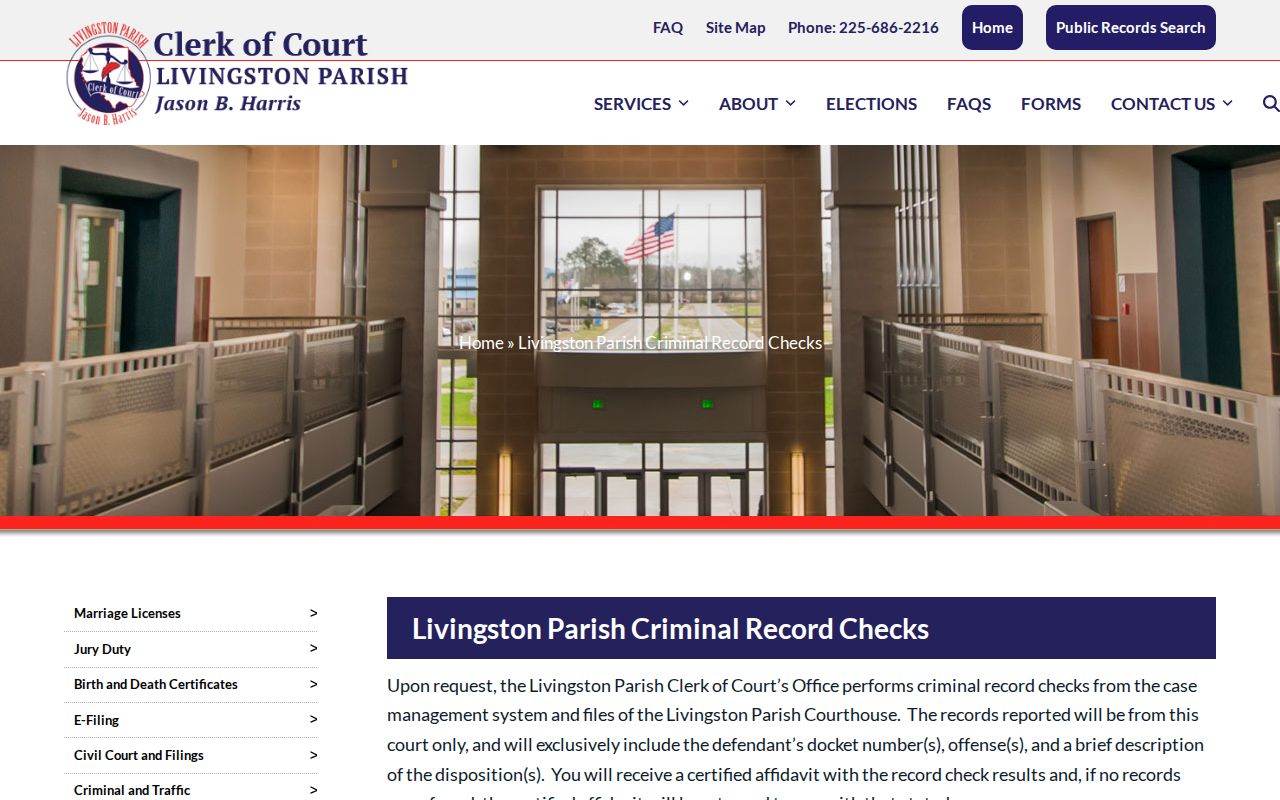
The image reinforces the key limit: this product searches Livingston Parish court data, not a nationwide history.
Inside a Livingston Parish Case File
A criminal case file is a group of records, not one report. The bill of information or indictment states what prosecutors filed. Minutes track official court events. Motions and notices show litigation and scheduling. A judgment and sentence establish the outcome and terms. A transcript is the reporter's verbatim account of a proceeding and must be ordered separately.
| Case Number & Court | Livingston Parish, 21st JDC division, and unique docket number. |
|---|---|
| Charging Document | Formal offense filed by bill of information or indictment. |
| Docket Entries | Filings, arraignment, motions, settings, plea or trial events. |
| Hearing Dates | Scheduled and completed proceedings; a setting alone proves no outcome. |
| Disposition & Judgment | Plea, verdict, dismissal, or other final court action. |
| Sentence & Conditions | Custody, suspended time, probation, fines, costs, and lawful conditions. |
Livingston Parish Transcript Requests
A transcript is not the same as the docket sheet or minutes. The 21st JDC transcript page directs requests to the clerk. Livingston's clerk says to provide the date, defendant, hearing division, and requester contact details, then submit the request in person or in writing. Ask for a transcript only when the spoken record is needed. For an outcome, a certified disposition or judgment may be more direct.
The court's direction helps separate reporter work from the clerk's docket, minute, and copy services.
Note: Collections questions about Livingston Parish criminal fines and costs go to 225-435-7002, not the transcript request channel.
How a Livingston Parish Case Moves
An arrest and booking may occur before the clerk has a case. The district attorney reviews the referral and decides which formal charge, if any, to file. Arraignment is the first plea on that filed charge. Motions and pretrial settings follow. The matter may end through dismissal, plea, trial verdict, or another lawful disposition. Sentencing follows a conviction. Each stage creates a different entry, so a single setting does not establish the final result.
Case flow: Charges Filed › Arraignment › Pretrial › Plea or Trial › Disposition › Sentencing
Livingston Criminal Filing Change
Beginning January 1, 2026, attorney criminal filings must be made on paper in person or filed electronically under Louisiana Clerks' Remote Access Authority procedures. This rule changes how attorneys deliver filings. It does not promise free public online document access. The clerk's separate notice about external COTT viewing means a remote reader should verify service status before relying on a portal.
The criminal e-filing notice states the current attorney procedure.
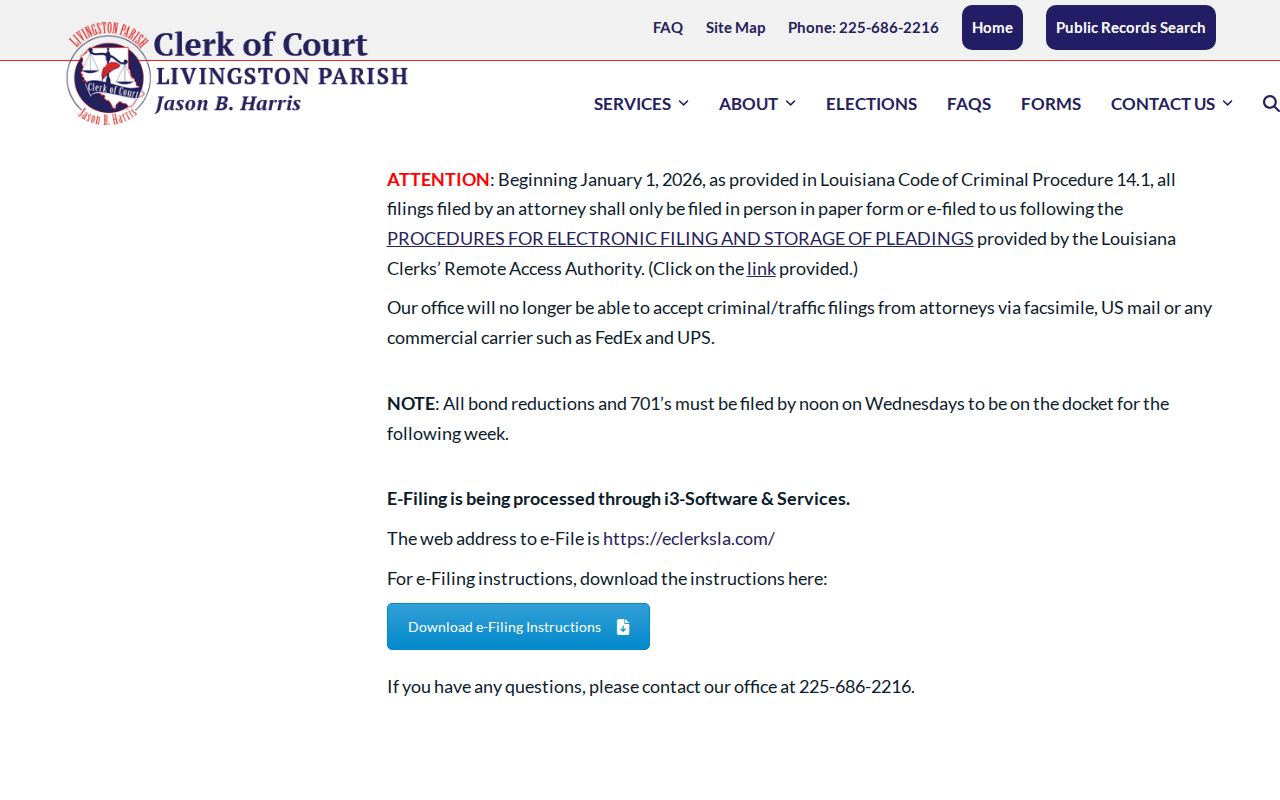
The distinction matters because electronic filing by counsel and public viewing are separate services.
Reading a Livingston Parish Docket
Read each Livingston Parish docket entry as one point in the case, not as a summary of the whole file. A bill of information or indictment states the formal accusation. Arraignment records the plea to that filed charge. A motion or pretrial setting shows that a procedural event was set or heard, but it says nothing by itself about guilt. A plea can be entered to an amended offense, so compare the accepted plea with the judgment. A trial setting does not prove that trial occurred.
- Minute entry
- The clerk's concise official record of what occurred in court.
- Attachment
- A bench warrant that may follow a failure to appear or other noncompliance; verify whether it was later recalled.
- Disposition
- The court's recorded outcome, such as dismissal, plea, verdict, or another final action.
- Appeal
- Review in a higher court; the clerk prepares the record, while the reviewing court keeps its own docket.
Article 893 or 894 references can affect a suspended sentence, set-aside, or later expungement question. Do not infer the legal effect from a short code alone. Read the minute and judgment, then ask the clerk for the exact disposition document when the outcome matters.
Case Record Access and Restrictions
Louisiana R.S. 44:1 defines public records broadly, while other Title 44 provisions govern inspection and copying. Court files from open proceedings are distinct from BCII's compiled fingerprint history. Juvenile, sealed, expunged, medical, protected victim, and confidential investigative material may be withheld or redacted.
Article 973 makes an expunged record confidential and removes it from public access without destroying it. If a Livingston Parish case is absent, first verify the parish, spelling, docket, division, and municipal-court possibility. Then ask the custodian whether the record is sealed, expunged, archived, or temporarily unavailable online. When access is denied, request the legal basis and any segregable, nonexempt portion.
The clerk's official FAQ covers local transcript, ticket, probation, and expungement routes.
Those separate routes show why the correct record request depends on the document needed.